
Free 
GT2 Pulley - the big collection updated
Printables
My Educational Mechanical Examples Series
This model is one of my educational mechanical mechanism examples on 80mm x 80mm base plates. You can find all models of the series in this collection => [Mechanical Mechanism Examples]
The present model
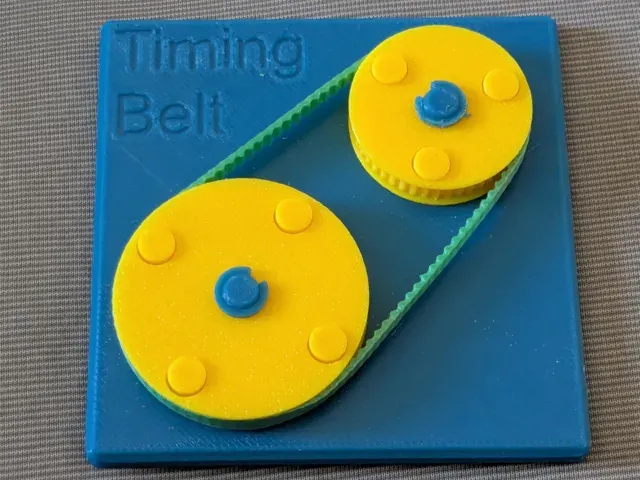
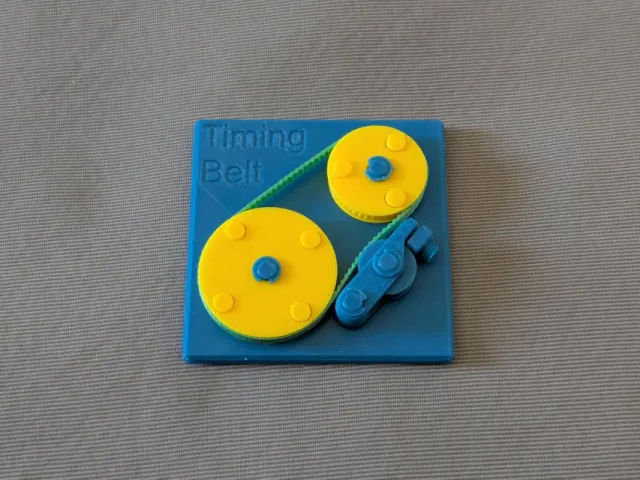
This is an educational model of timing belt & pulley.
The belt must be printed in a flexible material ( TPU 95A is recommended).
Two models are provided. One has no tensioner and the other has one.
I have confirmed that, even without the tensioner, the belt has little play.
Brief Description
A belt and pulley system transfers rotational motion between two separated shafts. A flexible belt is kept under tension and wrapped around cylindrical wheels called pulleys. When one pulley rotates, it pulls one side of the belt, which in turn drives the other pulley to rotate. Pulleys of different diameters can be paired to achieve a desired speed ratio between the two shafts.
A timing belt is a specialized type of belt featuring teeth on its surface that engage with corresponding teeth on the pulleys. These interlocking teeth prevent the belt from slipping on the pulleys, ensuring precise, synchronized rotation — hence the name timing belt. According to my observation, there are variety of tooth shapes for timing belts. Here I imitate one called S2M, which has a convex trapezoidal tooth shape with 2mm pitch. To be honest, however, I did not follow the specification exactly. So, they are just imitations.
In this model, the two shafts are arranged in parallel, but in practice the shafts can also be skewed — oriented in three dimensions so that they are neither parallel nor intersecting . With the help of belt guides or idler pulleys, a single belt can follow a complex path over a long distance and can even span more than two shafts simultaneously.
Timing belts are widely used in industrial machinery — and very likely in your 3D printer as well.
Related Models
- Chain and sprocket system is contained in “Educational Gear Example 3 - Lantern” .
Case
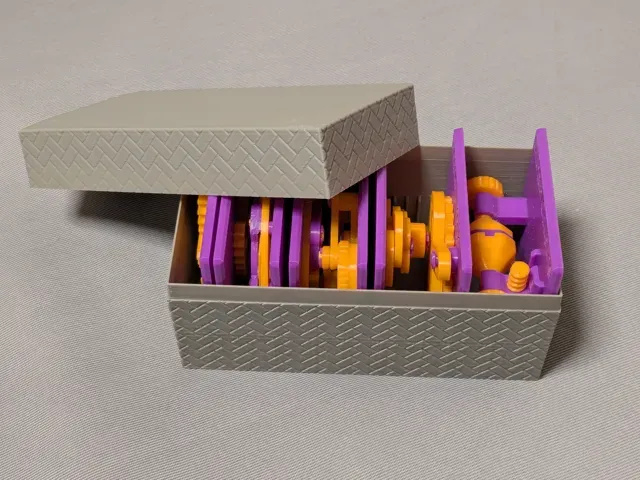
This model is compatible with the case included in my first set .
Printing
- Use the models named ???-printable.stl for printing . The models named ???-assembled.stl are provided just to show how they should be assembled. - Belt: - Use TPU 95A for the belt to have flexibility. - Set line width 0.4mm and standard wall generator ( NOT Arachne ) to have exactly two walls throughout the belt.
- Other parts: - Use well-dried PETG for other parts to have better dimensional accuracy. - Use 0.1 mm or 0.08 mm layer height to have smoother surfaces. - Select “Random” seam position to have smoother rotation. Randomly distributed seam should be easily worn out after some wearing.Printing Sanding and Filing
Note that, in this model, the rotation of the bases for bearings is intentionally made not too smooth.
Sometimes, the gears suffer from the stringing effect and/or elephant foot effect, resulting in a too tight fit to the shafts (they are designed with a 0.15 mm radial clearance).
If you see rough surface on the shafts due to stringing, sand off the roughness with a small piece of sand paper.
If you feel the gears do not rotate smoothly due to an elephant effect, widen the hole slightly by using a thin round bar file.
Without those issues, the parts should rotate very smoothly with minimal friction.
Assembly
Secure the pulley on the shafts with the retaining ring.
Other examples
You may also be interested in the models in my educational mechanical mechanism examples.
Find them in this collection: https://makerworld.com/collections/15048577-my-educational-mechanism-models
Happy printing!
Acknowledgement
I got into gears thanks to K.$uzuki 's amazing articles and YouTube videos . Many of the mechanisms shown in this series came from the introductions on his website . He also makes excellent gear models himself. This series wouldn’t have existed without his inspiration.
I learned a lot about technical detail of designing gear tooth profiles from Haguruma-No-Hanashi website . I’m truly grateful for that.
License
- The 3D model(s) are licensed under Creative Commons Attribution 4.0 International . - However, the text and images on this page are copyright reserved.
0.08mm ExFine, Randome Seam With Tensioner, Classic wall generation for belt, Arachne for others.
The first plate is grouped into two merged objects, each corresponding to one color. By default it prints as a single color — no changes needed. For multi-color printing, select each merged object and assign it a different color/filament.
0.08mm ExFine, Randome Seam Without Tensioner, Classic wall generation for belt, Arachne for others.
The first plate is grouped into two merged objects, each corresponding to one color. By default it prints as a single color — no changes needed. For multi-color printing, select each merged object and assign it a different color/filament.




Names are used only to indicate the source of a result. Polyzon is not affiliated with the listed sites.