
Free 
Micro- aircraft "Hummel RC"
MakerWorld
SIMPLE . FLYING . FUN
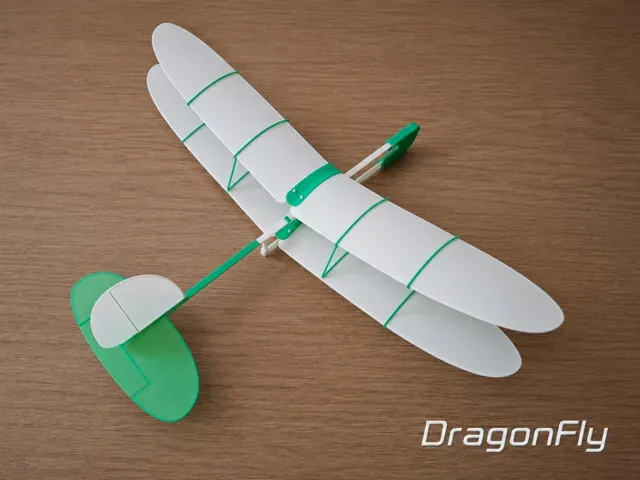
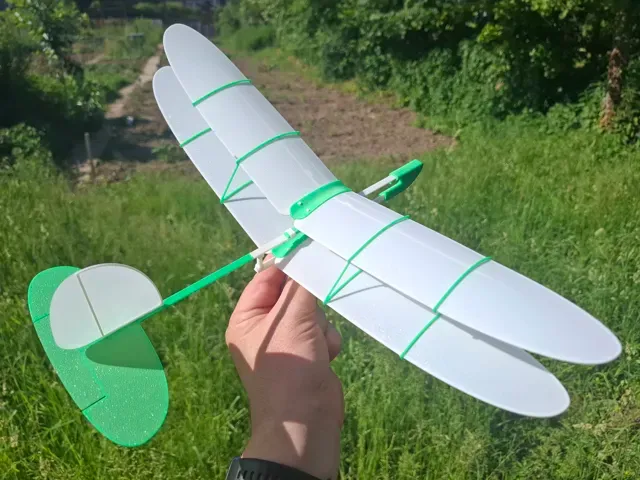
DragonFly is a fun compact biplane glider with excellent flight characteristics.
For a long time, I wanted to create a simple and durable biplane model that still keeps good aerodynamic efficiency and smooth flight behavior. DragonFly combines a lightweight structure, elegant lines and stable free-flight performance.
Designed for outdoor flights in calm weather, the model features an adjustable wing position for easy CG and pitch tuning.
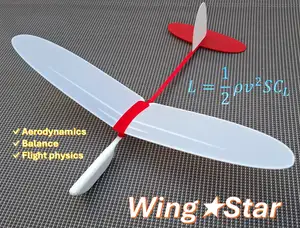
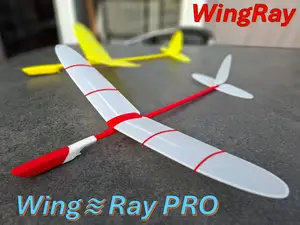
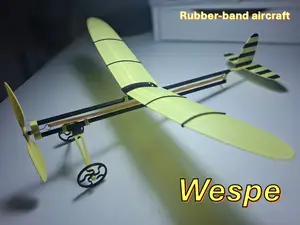
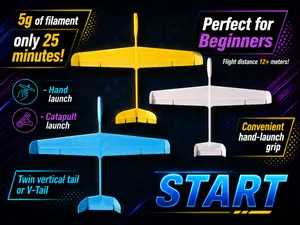
DragonFly also inherits some of the best ideas and features from my previous designs: WingStar , COMET , Wespe and SkyStar .
1 - Model Data
Wingspan: 405 mm, Length: 320 mm Wing chord: 60 mm Model mass: 40g
Actual revision: V0.2 (ncreased Nose weight; increased fixing Clamp thickness).
V0.1 (improved Fin fitting slot tolerance; improved Nose mount tolerance).
Optional TPU Nose Weight
For additional safety, an optional TPU nose weight is available (see the corresponding optional print profile).
The soft TPU nose helps reduce the risk of damage during accidental impacts and contains a removable ballast insert.
2 - Materials, Settings, Printing
Model design created and tested using Bambu PLA Basi c. Use this material for best results.
Do NOT use PLA Matte, especially for the wing parts. Printed parts may deform after removal from the Plate due to internal material strains after cooling.
Use recommended print settings.
Note: The print profile for A1 mini use slightly higher material flow coefficient (1.03 instead of 1.00).
For reliable printing:
- Clean the printing Plate before printing. - After printing, remove the Plate and let it cool for 3-4 minutes - Do not remove parts while the Plate is hot 3 - Model Assembly
The model consists of 13 parts, as shown in the figure.
1 – Nose, 2 – A-Beam, 3 – B-Beam, 4 – V-Beam, 5 –Tail, 6 – Fin, 7 – Left Wing (2 pcs), 8 – Right Wing (2 pcs), 9 – Rib Frame (2 pcs), 10 – Rib (4 pcs), 11 – Central Bracket, 12 – Dual-pin (2pcs), 13 – Clamp (2 pcs).
Assemble the tail unit and fuselage as shown.
Assemble the bottom wing as shown in the figure. Use Dual-pin (12) to fix wings.
Assemble the upper wing as shown. Fix upper wings with Dual-pin (12).
After installing and fixing the wing surfaces, uninstall Rib Frames (9) on both sides.
Finally, install the Ribs on both sides (10).
Wing assembly completed.
To install the wing on the fuselage, pull the fuselage beam through predefined guide points on the wing Central Bracket, as shown in the picture. A slight pushing force may be gently applied if needed. While sliding the wing into position, install one Clamp (13) onto the upper fuselage beam, directly after the first upper guide point of the Central Bracket, as shown in the figure.
After installing the wing onto the fuselage, set a gap of approximately 5-8 millimeters between the rear V-Beam (4) and the rear lower edge of the Central Bracket.
Fix the wing position on the fuselage with Clamps.
Install the Nose (1) part. Model assembly completed.
4 - Model Flight
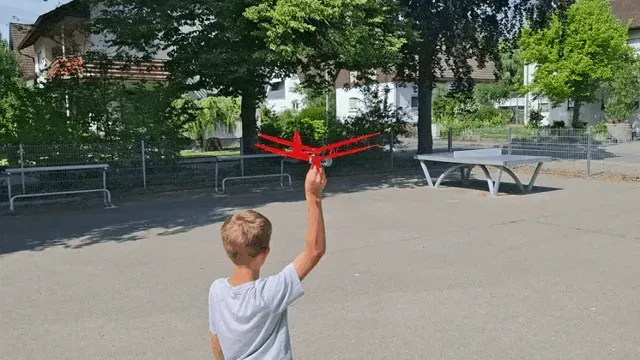
Model is pre-balanced during assembly. Launch the model outdoors in calm weather conditions. Recommended wind speed: up to 5 km/h (≈1.4 m/s, ≈2.7 knots) . Always launch the model directly into the wind .
DragonFly can be flown using two different launch techniques.
1. Gentle Glide Launch
This is the recommended launch method for initial trimming and normal flights.
Hold the model level and launch it with a gentle push and a slight nose-down attitude. The model should smoothly transition into a stable glide with minimal altitude loss.
If the model dives strongly, first try increasing the launch speed. If increasing the launch speed does not help, then:
- Move the wing slightly forward - OR bend the elevator slightly upward If the model pitches up or stalls , first try reducing the launch speed. If reducing the launch speed does not help, then:
- Move the wing slightly backward - OR bend the elevator slightly downward 2. Dynamic Climb Launch
DragonFly, V0.2, Bicolor Profile optimized for Bambu Lab PLA Basic.
0.12mm layer, 2 walls, 100% infill. Material flow coefficient 1.00
1st layer 0.16 mm. 1st layer print – nozzle temperature 225 deg, bed temperature 60 degrees.
Manual support ON (tree mode).
Print can be done on smooth and textured plates.
Before printing, clean your Plate carefully.
Cool down the plate with completed printing before the removal of the parts.
DragonFly, V0.2, Singlecolour Profile optimized for Bambu PLA Basic.
0.12mm layer, 2 walls, 100% infill.
Material flow coefficient 1.00
1st layer 0.16 mm. 1st layer print – nozzle temperature 225 deg, bed temperature 60 degrees.
Manual support ON (tree mode)
Print can be done on smooth and textured plates.
Before printing, clean your Plate carefully.
Cool down the plate with completed printing before the removal of the parts.
DragonFly, V0.2, A1 Mini Profile optimized for Bambu PLA Basic.
0.12mm layer, 2 walls, 100% infill.
Material flow coefficient 1.03
1st layer 0.16 mm. 1st layer print – nozzle temperature 225 deg, bed temperature 65-67 degrees.
Initial layer line width 0.52 mm
Manual support ON (tree mode)
Print can be done on smooth and textured plates.
Before printing, clean your Plate carefully.
Cool down the plate with completed printing before the removal of the parts.
OPTIONAL - Safe TPU Nose OPTIONAL – TPU Nose
Profile optimized for Bambu TPU 90A.
0.16mm layer, 2 walls,
Nose Part density - 15% infill. Nose part printing speed reduced ( 60-100 mm/s ).
Balance (round part) density – 100% infill. The Balance part can optionally be printed from PLA.
Print can be done on smooth and textured plates.
Before printing, clean your Plate carefully.

Names are used only to indicate the source of a result. Polyzon is not affiliated with the listed sites.