
Free 
Ultimate Filament Clip Clamp v2
Printables
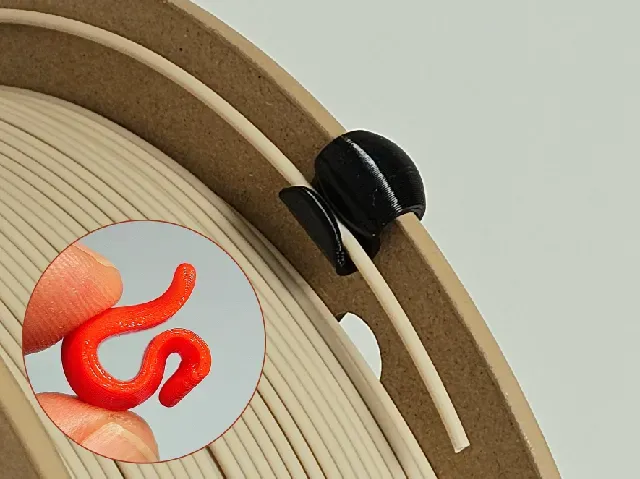


If you already print TPU, this will likely become your default filament clip.
This started as a simple idea: what if a filament clip actually used TPU the way it should.
Instead of fighting flexibility, this design uses it to make the clip easier to use, more tolerant to different spool shapes, and much more forgiving in daily use.
After using it for over a month, it became my default clip. No forcing, no threading — just slide the filament in and it holds naturally.
What makes it different:
- Works across many spool rim designs (cardboard or plastic, thin or thick, flat or irregular edges)
- Can be used on full spools — no deep insertion needed
- Slide-in use: no threading, no forcing
- Two ways to use it: spool edge or inside as a tie
- TPU keeps its grip and flexibility inside filament dryers
- Fast and economical to print (~8 min, ~0.43 m of TPU)
- Tested in TPU 95A and 85A
Printing Instructions
The clip was designed primarily for TPU.
For TPU, the model should be printed fully solid using only walls , with no top/bottom layers and no infill. By setting 4 walls , the slicer naturally creates a compact, solid part with layer lines aligned to the main stress directions of the clip.
TPU settings:
- Walls: 4
- Top layers: 0
- Bottom layers: 0
- Infill: 0%
This results in the best balance of grip, flexibility, and long-term durability even inside filament dryers. Tested successfully in TPU 95A and 85A .
Commercial License & More Benefits
Expand your business opportunities with a commercial license for all my designs, plus exclusive benefits such as early and free access to new models. Get your benefits here: https://www.printables.com/@jajaum3d#join.@jajaum3d.64
Description
GlideLock Filament Clip was designed as a practical and flexible alternative to traditional rigid filament clips that rely on tight tolerances, small holes, or excessive force to hold the filament in place.
Instead of threading filament through narrow openings or forcing it into stiff clamps, GlideLock uses a side-entry geometry combined with controlled flexibility. This allows the filament to slide in naturally and lock securely without stress, making it faster to use, easier to reposition, and significantly more forgiving in daily use.
Compatibility was a core design goal. Filament spools vary widely — cardboard or plastic, thin or thick rims, flat edges or irregular profiles — and many clips only work well under very specific conditions. GlideLock was tested across multiple spool types and sizes, including full spools, and proved to be reliable without requiring deep insertion into the spool core.
The clip supports two natural use cases:
- On the spool edge, as a traditional filament clip
- Inside the spool, acting as a filament tie or filament holder
Both use cases were tested in real-world conditions, including inside filament dryers, where material behavior becomes more critical.
Material choice plays a key role in performance. While the model can be printed in PLA or PETG with adjusted settings, it was primarily designed for TPU.
Flexible filament provides better grip, adaptability, and long-term durability. TPU versions maintain holding force more consistently under heat, making them especially suitable for filament dryers where rigid materials often loosen over time.
From a printing perspective, GlideLock is intentionally small, efficient, and optimized for fast production. It prints in just a few minutes using minimal material, making it practical to produce multiple units at once. The geometry was designed around wall-only construction, aligning layer lines with the main stress directions to maximize strength and flexibility without unnecessary infill.
GlideLock does not aim to reinvent filament storage systems. Instead, it focuses on solving small but recurring usability problems in a simple, reliable, and efficient way. It is compact, easy to use, compatible with a wide range of setups, and designed to stay out of the way once installed.





Names are used only to indicate the source of a result. Polyzon is not affiliated with the listed sites.