
Free 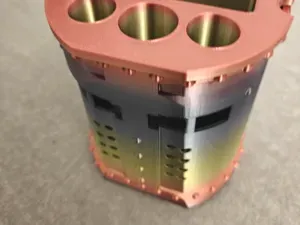
Great Helm Makeup Organizer — no supports
MakerWorld


Great Helm Makeup Organizer
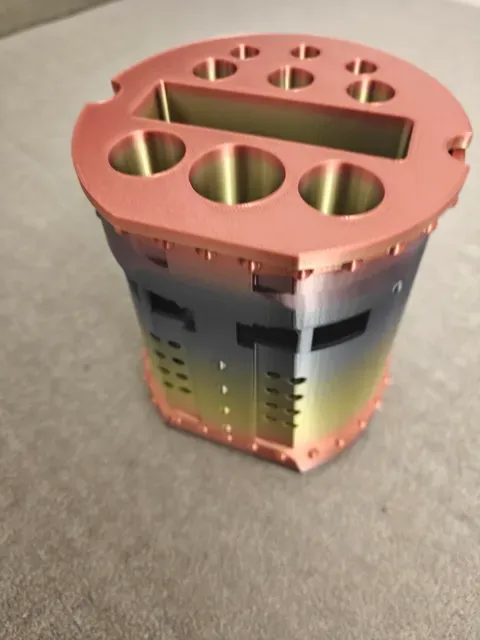
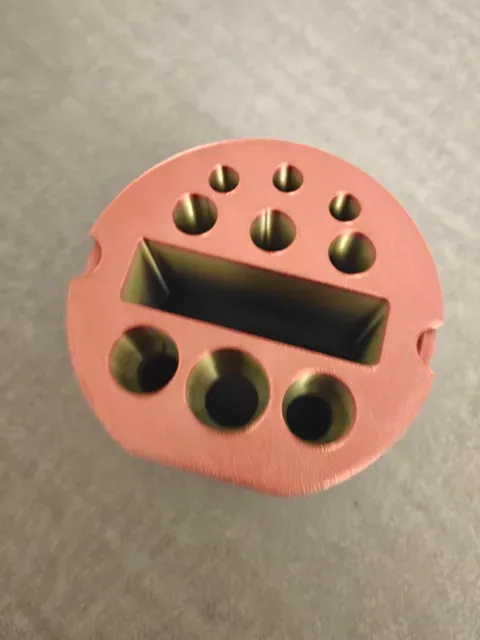
A 13th-century flat-topped great helm — and on the inside, a rather careful makeup organizer. Brushes stand up out of the open crown like a crest, mascara and lipsticks sit in the face rank where you can grab them, and a compact palette stands proud of the top in a slot down the middle.
2 parts · 134 × 125 × 150 mm assembled · 307 g · no supports, no hardware, no glue, no paint. Assembly is dropping one plate onto a rim.
The organizer is the crown plate
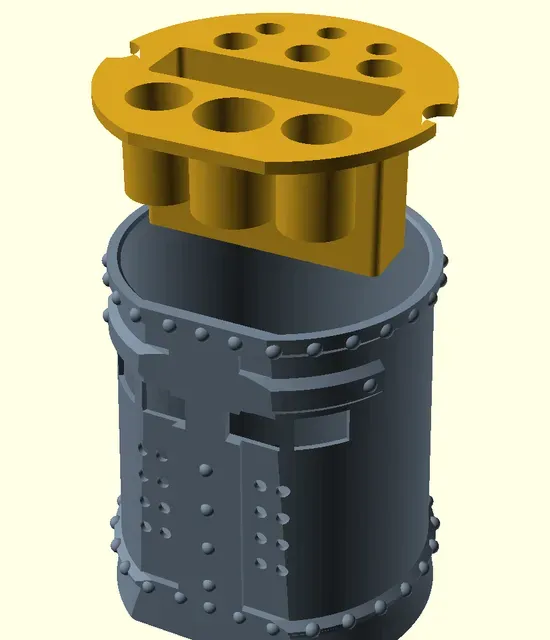
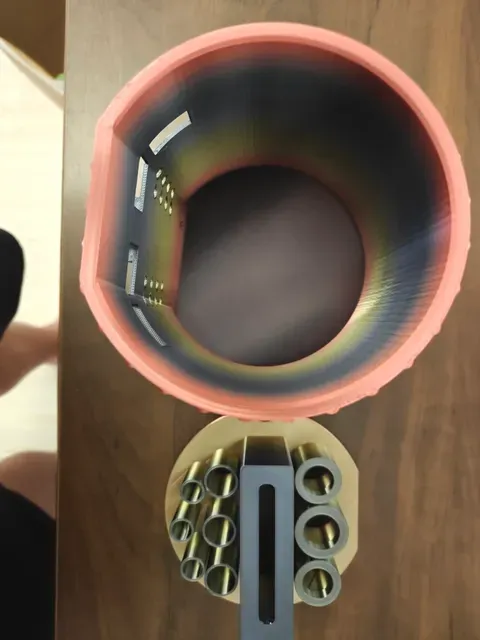
Lift it off and the whole bore field comes with it — nine tubes and a palette pocket hanging under a riveted lid. The helm underneath is a smooth open drum.
Every brush bore goes straight through
Push a brush into the liner and it stands bristles-up while its handle hangs in the helm underneath. Because the six brush bores are one diameter all the way through rather than a pocket with a floor, the handle drops until the brush hangs on its own taper — which is what makes a 120 mm brush and a 220 mm brush stand at the same height. They grip the handle , never the ferrule, so the bristles never splay against a bore wall.
The bores are cut to measured stock, not guessed:
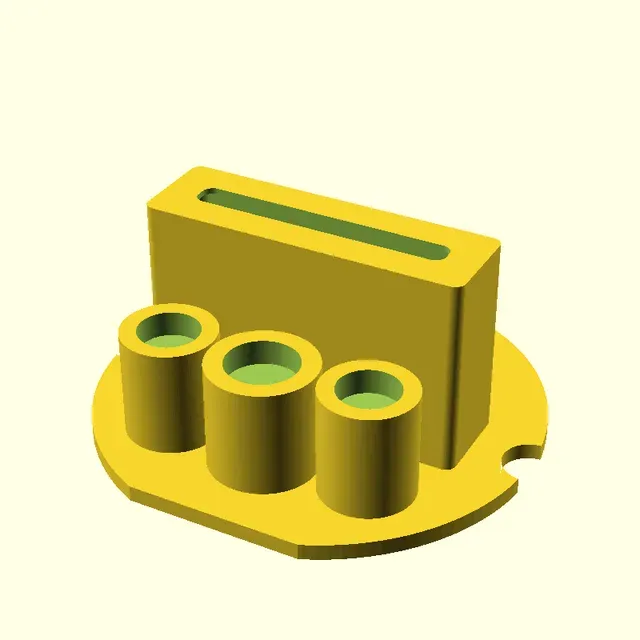
One bore Ø27, necks to Ø20 ..... mascara (stock 20-26 mm) Two bores Ø23, necks to Ø17 ..... lipstick (stock 19-22 mm) Three bores Ø16, through ........ powder / blusher / foundation brushes Three bores Ø11, through ........ eye and lip brushes One slot 88 x 24, 55 deep ....... one thick or two thin compacts, 60-95 mm
The three tube bores neck down at the far end instead of bottoming out, so a mascara stands on its shoulder proud enough to pinch out. The palette rests on an 8 mm ledge with the middle left open.
There is not one blind hole in it
That is a structural answer to the thing that kills makeup organizers, not a claim in the copy. Powder, cream and glitter fall straight through into the helm rather than packing into the bottom of a pocket where they live forever. Nothing anywhere is narrower than 7 mm, and the helm's interior is a smooth drum with no ribs, ledges or internal corners.
To clean it: lift the liner out by the two finger notches, rinse it under a tap — both ends of every hole are open — then tip the helm out and wipe it.
The two parts
great_helm.stl 1x 134 x 125 x 150 mm 199 g shell, face, gorget, the cavity great_helm_liner.stl 1x 125 x 125 x 60 mm 108 g crown plate + the whole bore field
- helm — the shell: flared gorget skirt, barrel body tapering in toward the crown, two riveted hoops, a proud cross of nasal and brow bands, split sights and a breath-hole field. Open at the top.
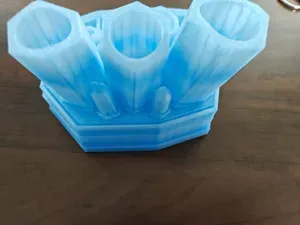
- liner — the crown plate. Nine tubes and the palette pocket hang under a riveted flange that drops onto the crown hoop.
The flat face keys the liner. The front of the helm is planed flat and the liner's flange is planed to match, so it only seats one way round — the tube rank always ends up at the face.
Printing
Two plates. Neither needs support. Both print in the pose the STL is saved in, flat on the bed, no flips. 0.2 mm layers, 3 walls, 15 % infill.
great_helm.stl gorget rim on the bed every section narrows going up great_helm_liner.stl flange down, tubes UP necks and ledge narrow upward
The liner ships in its print pose, which is upside-down from how it is used. Print it as exported, then flip it over and drop it onto the helm.
Two colours cost nothing here: the parts print on separate plates, so a steel or graphite helm with a brass or gold liner is two spool changes, not a purge tower. The photos are a single copper-black-gold gradient silk PLA.
Details that were designed rather than left to luck:
- Each sight is split in two by a brow strut , so no opening bridges more than about 20 mm.
- Every proud band has 45° top and bottom faces , so the bands, hoops and rivets carry themselves.
- Breath holes are Ø5 , small enough that the wall simply arches over them.
- The gorget rim carries a 1 mm chamfer (no elephant's foot) and the crown bore has a 1.2 mm lead-in flare, so the liner drops in rather than being aimed.
Assembly
- Print both parts.
- Turn the liner over so the tubes point down.
- Drop it into the helm. The flange sits on the crown hoop and the flat at the front tells you which way round it goes. That is the whole assembly.
Parametric
The OpenSCAD source ships with it. Bore diameters, the palette slot, the helm height and base diameter are all named variables at the top of the file ( helm_h , helm_base_d and the liner_bores table), so the rack can be re-cut to whatever is actually in your drawer.



Names are used only to indicate the source of a result. Polyzon is not affiliated with the listed sites.