
Free 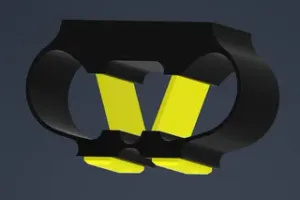
Ender3 V3 SE/KE/S1 anti vibration feet V2
Printables


Technical background:
Input Shaping on Klipper can be tuned with G-Sensor. When using a rooted Nebula Pad FW, the tuning produces the measured vibrations profile .csv and suggests shaper settings + max acceleration under these settings. And since a rooted Nebula Pad has a crippled Klipper, I couldn't generate the graphs directly on it, so thanks to https://github.com/theycallmek/Klipper-Input-Shaping-Assistant, I was able to generate them on the PC. Hopefully they aren't missing, by the few inline reports in Fluidd I've correlated, look fitting.
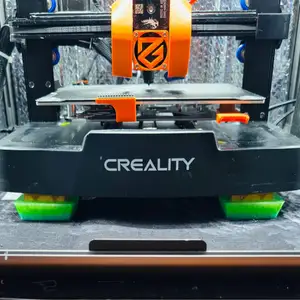
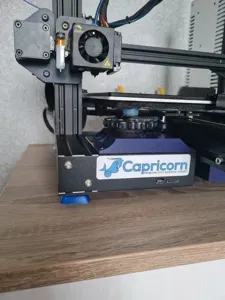
I've used this to recalibrate Input Shaping after installing gauntry braces for Ender3 v3 SE/KE, and found out that the stiffened construction can actually hurt Input Shaping and reduce the max acceleration if the printer is mounted on an unstable surface and transfers its vibrations. So I've experimented and found out that on soft feet made of thick foam rubber the vibrations are suppressed better (despite being larger!) and the max acceleration vastly increases, and it brought me to design the TPU feet. After tuning the construction, the results even on the unstable desk I have are very encouraging.
I'm attaching the graphs of the runs for the interested, please pay attention to the Y axis scale on the graphs! Sometimes it's 1e3 (1,000), sometimes it's 1e4 (10,000), need to correlate properly. The filenames are self-explanatory, I hope. “Partial” in the run with the current design is because only the rear feet, underneath the brace and the heavier printer side, are this design - the front feet were used from a stiffer, less effective design, but they didn't matter much as I've compared them with front foam feet and got almost the same results. I didn't even bother printing them with the latest design eventually, to avoid unnecessary waste.
Actual design:
Since the foam rubber feet quickly compressed and lost suspension quality, I wanted to download some simple TPU feet, but barely found a few models, and none suited my needs (I didn't want a large model, on the contrary, wanted something thin and relatively soft). So I decided to create something very simple, and here it is, after testing of 3 variations to find the structural strength and infill that would allow it to support the printer while remaining flexible enough.
Mounting is as simple as sliding them on the regular rubber feet. They should hold nicely.
Couldn't add G-Code, since I have custom macros in it, running Nebula Pad + rooted Klipper. I can try substituting the macros with the regular init and put here, if there is a demand, but I suggest using slicer.
Slicer settings ( !!! IMPORTANT !!! )
- Material: TPU 95A - For softer TPU you will need to increase the infill density - Resolution: 0.2, standard 0.4mm nozzle (2 walls, 4 top/bottom) - Infill type: Lines - Infill density: 8% - Supports/Raft/Brim: no - Temperature: whatever you print TPU at, for me it's 225 deg C nozzle and ambient bed.




Names are used only to indicate the source of a result. Polyzon is not affiliated with the listed sites.
Comments 0
Loading comments…