
Бесплатно ![[BETA] ManaFly 3.5" Generative FPV Drone Frame](https://cache.polyzon.org/api/img?url=https%3A%2F%2Fmakerworld.bblmw.com%2Fmakerworld%2Fmodel%2FUS47dd6c076e6850%2Fdesign%2F9b5575ccd05674b6.png&w=300)
[BETA] ManaFly 3.5" Generative FPV Drone Frame
MakerWorld
![[BETA] ManaFly 3" Generative FPV Drone Frame](https://cache.polyzon.org/api/img?url=https%3A%2F%2Fmakerworld.bblmw.com%2Fmakerworld%2Fmodel%2FUScf29dce00d2d45%2Fdesign%2F2025-11-17_db267916734e6.png&w=640)
![[BETA] ManaFly 3" Generative FPV Drone Frame — Фото 2 из 17](https://cache.polyzon.org/api/img?url=https%3A%2F%2Fmakerworld.bblmw.com%2Fmakerworld%2Fmodel%2FUScf29dce00d2d45%2Fdesign%2F2025-11-15_ff1655011e7198.png&w=640)
![[BETA] ManaFly 3" Generative FPV Drone Frame — Фото 3 из 17](https://cache.polyzon.org/api/img?url=https%3A%2F%2Fmakerworld.bblmw.com%2Fmakerworld%2Fmodel%2FUScf29dce00d2d45%2Fdesign%2F2025-11-17_93ab2e94faddc8.png&w=640)
![[BETA] ManaFly 3" Generative FPV Drone Frame — Фото 4 из 17](https://cache.polyzon.org/api/img?url=https%3A%2F%2Fmakerworld.bblmw.com%2Fmakerworld%2Fmodel%2FUScf29dce00d2d45%2Fdesign%2Ffb1066d5e47f9f13.jpg&w=640)
![[BETA] ManaFly 3" Generative FPV Drone Frame — Фото 5 из 17](https://cache.polyzon.org/api/img?url=https%3A%2F%2Fmakerworld.bblmw.com%2Fmakerworld%2Fmodel%2FUScf29dce00d2d45%2Fdesign%2Fe9ed26228ef3828f.png&w=640)
![[BETA] ManaFly 3" Generative FPV Drone Frame — Фото 6 из 17](https://cache.polyzon.org/api/img?url=https%3A%2F%2Fmakerworld.bblmw.com%2Fmakerworld%2Fmodel%2FUScf29dce00d2d45%2Fdesign%2F6925f0b06c08c3d9.png&w=640)
![[BETA] ManaFly 3" Generative FPV Drone Frame — Фото 7 из 17](https://cache.polyzon.org/api/img?url=https%3A%2F%2Fmakerworld.bblmw.com%2Fmakerworld%2Fmodel%2FUScf29dce00d2d45%2Fdesign%2Fc3d8678f1746d36c.jpg&w=640)
![[BETA] ManaFly 3" Generative FPV Drone Frame — Фото 8 из 17](https://cache.polyzon.org/api/img?url=https%3A%2F%2Fmakerworld.bblmw.com%2Fmakerworld%2Fmodel%2FUScf29dce00d2d45%2Fdesign%2Fd04f9b6e38e7783f.jpg&w=640)
![[BETA] ManaFly 3" Generative FPV Drone Frame — Фото 9 из 17](https://cache.polyzon.org/api/img?url=https%3A%2F%2Fmakerworld.bblmw.com%2Fmakerworld%2Fmodel%2FUScf29dce00d2d45%2Fdesign%2F42f6310bc848d6cb.png&w=640)
![[BETA] ManaFly 3" Generative FPV Drone Frame — Фото 10 из 17](https://cache.polyzon.org/api/img?url=https%3A%2F%2Fmakerworld.bblmw.com%2Fmakerworld%2Fmodel%2FUScf29dce00d2d45%2Fdesign%2Ff92cbf56b1340e8f.png&w=640)
![[BETA] ManaFly 3" Generative FPV Drone Frame — Фото 11 из 17](https://cache.polyzon.org/api/img?url=https%3A%2F%2Fmakerworld.bblmw.com%2Fmakerworld%2Fmodel%2FUScf29dce00d2d45%2Fdesign%2Fe41b612c71cc8dea.png&w=640)
![[BETA] ManaFly 3" Generative FPV Drone Frame — Фото 12 из 17](https://cache.polyzon.org/api/img?url=https%3A%2F%2Fmakerworld.bblmw.com%2Fmakerworld%2Fmodel%2FUScf29dce00d2d45%2Fdesign%2Fcfbef40c70bcdffd.png&w=640)
![[BETA] ManaFly 3" Generative FPV Drone Frame — Фото 13 из 17](https://cache.polyzon.org/api/img?url=https%3A%2F%2Fmakerworld.bblmw.com%2Fmakerworld%2Fmodel%2FUScf29dce00d2d45%2Fdesign%2Fa00df415bb36b083.png&w=640)
![[BETA] ManaFly 3" Generative FPV Drone Frame — Фото 14 из 17](https://cache.polyzon.org/api/img?url=https%3A%2F%2Fmakerworld.bblmw.com%2Fmakerworld%2Fmodel%2FUScf29dce00d2d45%2Fdesign%2Ffa2fdce73c6c3fae.png&w=640)
![[BETA] ManaFly 3" Generative FPV Drone Frame — Фото 15 из 17](https://cache.polyzon.org/api/img?url=https%3A%2F%2Fmakerworld.bblmw.com%2Fmakerworld%2Fmodel%2FUScf29dce00d2d45%2Fdesign%2F40732843fcd86390.png&w=640)
![[BETA] ManaFly 3" Generative FPV Drone Frame — Фото 16 из 17](https://cache.polyzon.org/api/img?url=https%3A%2F%2Fmakerworld.bblmw.com%2Fmakerworld%2Fmodel%2FUScf29dce00d2d45%2Fdesign%2Fecff895f3efde7eb.gif&w=640)
![[BETA] ManaFly 3" Generative FPV Drone Frame — Фото 17 из 17](https://cache.polyzon.org/api/img?url=https%3A%2F%2Fmakerworld.bblmw.com%2Fmakerworld%2Fmodel%2FUScf29dce00d2d45%2Fdesign%2Ff9bb8f4813864d6e.gif&w=640)
This frame is currently being developed. If you want to help us improve it, submit your feedback in out discord: https://discord.gg/H9avyxBVJ7
___________________
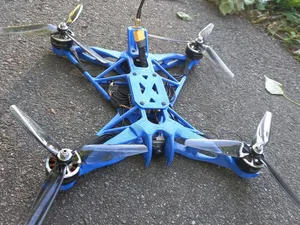
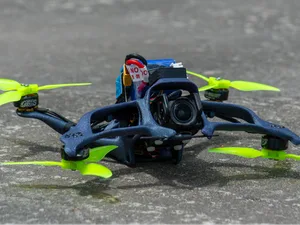
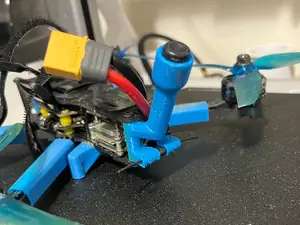
ManaFly 3” is a fully 3D Printed unibody FPV drone frame engineered from the ground up for optimal flight characteristics, strength, and ease of use. Created using generative optimized design, ManaFly pushes the limits of what’s possible with 3D printing.
Heads up: It survives crashes worse than carbon fiber, so not reccomended if you'll crash a lot! However, stiffness is good, it is super light, and for flying fast or cinematic/long range it works great.
Why ManaFly Exists
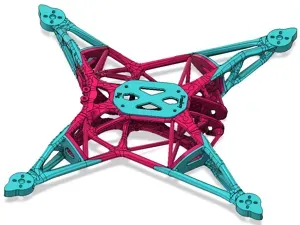
Everyone knows that carbon fiber sheets are way stronger than the filaments we use for 3d-printing. Therefore, most people assume that a 3d printed drone frame will suck in comparison with a traditional frame. That is true for most of the 3d-models you will find, but for ManaFly we have used generative design, tons of iterations and carefully engineered load constraints to make a 3d-printed frame that can perform. Even though the material itself is weaker, the shape is optimized to get the most out of every gram of material, making a strong rigid frame without carbon fiber.
And the best part? Each frame only costs about $1 . Many times cheaper than a traditional frame.
Unlike most 3d-printed frames, ManaFly is designed to be printed with 100% infill. The optimized skeletal structure makes this possible without adding too much weight.
Crash? No Problem.
Yes, a 3D-printed frame will likely break more easily than one made of carbon fiber. So we solved the problem differently:
We made electronics transfer effortless.
If you crash, simply:
- Unscrew your electronics - Transfer them into a spare frame and screw them in place - Be back in the air in minutes No repairing arms. No resoldering. No metal cages. No rebuilding stack spacers. No fuss.
What ManaFly is Good At:
- Cheap & repeatable — Print multiple backups easily, each frame costs as little as $1 - Zero assembly required — Unibody design printed in one piece. Component transfer is fast and easy - Strong but lightweight — ~35g weight with 6 walls & 100% infill - Wide compatibility — ManaFly is compatimble with almost all 3" stacks - Optimized via generative design for stiffness and resonance control - No fancy materials needed — Regular PETG or ABS works perfectly - Designed for real crashes — Lots of carefully designed load cases plus real world testing and iteration - Optimized for flight — Low resonance, high stiffness, predictable handling Boost Me If you like my models, please consider dropping me a boost, comment and rate the profile! Any of these things keeps me motivated to Keep going! Thank you!
Compatibility
Manafly is compatable with almost all 3" stacks. Below is a list of the mounting patterns that the frame supports.
Flight Controller
- 25.5 × 25.5 mm AIO - 20 × 20 mm FPV stack Motors
- Any motors with a 9-12mm mounting pattern (Recommended: 1404 motors) VTX
Compatible with every major 20 mm / 25.5 mm mounting system:
- DJI O3 - DJI O4/ 04 Pro - Walksnail Avatar - HDZero - Analog VTX Camera
- DJI O3 - DJI O4 / O4 Lite - Walksnail Avatar - HDZero Nano / Micro - Analog Mini / Micro / Nano Prop Size
- 3 inch props (standard) Print the camera adapter that matches your setup.
- DJI O4 Camera Mount - Analog 14 mm, HDZero Nano Camera Mount - DJI O4 Lite Camera Mount - DJI O3, Walksnail, Analog 21 mm / 19 mm, HDZero Micro Video Antennas
- Almost all digital antennas - MMCX antennas - Supports single antenna and dual antenna setups Filament
We recommend to use one of these three filament types for printing ManaFly:
Easy, cheap and durable: PETG
If you want a cheap and easy to print option that is also relatively durable, we recommend using PETG . Even though PETG has a lower tensile strength than most other filaments, it can deform a lot before fracturing. It is also one of the filament types with the strongest layer adhesion. Therefore, it is great at absorbing impacts when the drone crashes without breaking. It is also cheap and easily accessible.
Slightly higher performance: ABS
Another relatively cheap option is to use ABS . ABS is about 20% lighter, which will reduce the weight of the frame from 33g to 27g. It is also stiffer than PETG. How durable it is depends a lot on the print quality and filament quality (don't buy super cheap ABS), but if you have a good printer and filament it can be about as durable as PETG. You will need an enclosed printer with ventilation to print with ABS, as it gives off poisonous fumes while printing.
Try at you own risk: PA6-CF
If you are willing to spend a bit more per frame, we recommend using PA6-CF . The frame will be able to absorb up to twice as much energy before it breaks compared to PETG and ABS, so it will survive crashes better. The durability of the frame when printed with PA6-CF will be highly sensitive to the print quality, so we only recommend this if you have a good enclosed printer and can dry the filament completely before printing. We do not recommend printing with other Nylon-based filaments like PPA-CF and PPS-CF. These are super strong, but they have a very low impact strength in the Z-direction, and that is the most indicative parameter for how well the frame will survive crashes.
NB! Some people in the Discord have been informing us about vibration issues when using this filament or other filaments with similar stiffness, so print in this filament at your own risk!
What to look for if choosing other filaments
If you are wondering if another filament you have found is good for ManaFly, the best way to tell if it will make for a durable frame is to look at its impact strength in the Z direction. This parameter indicates how much energy the filament can absorb before breaking between the layers. ManaFly usually breaks between the layers, so a higher impact strength in the z-direction will mean that the frame can survive crashes better.
Print Settings (Recommended)
- Infill: 100% - Walls: 6 - Filament Use: ~30 g - Print Orientation: Flat / horizontal for maximum strength Assembly
When assembling the drone, it's very important that you don't use too much torque on the screws, as this can easily break the plastic around the screw.
How good is ManaFly compared to a carbon fiber frame?
PETG Print Profile BETA 4.0 (Latest) 0.2mm Layer Height
6 Wall loops
100 percent infill
Happy Printing
ABS Print Profile BETA 4.0 (Latest) 0.2mm Layer Height
6 Wall loops
100 percent infill
Only 30 grams for the model + 10 grams for support
Happy Printing
0.2mm layer, 6 walls, 100% infill






Названия используются только для указания источника результата. Polyzon не аффилирован с перечисленными площадками.