
$ 29.00 
Model of Marcel Duchamp's Bicycle Wheel by william Cromar: Full Scale Edition
Printables

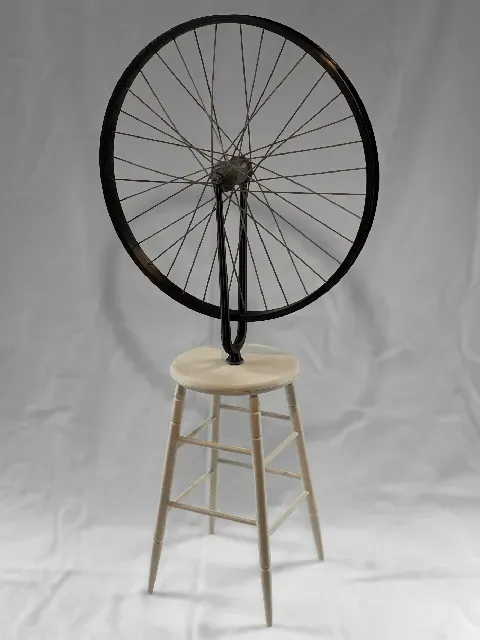

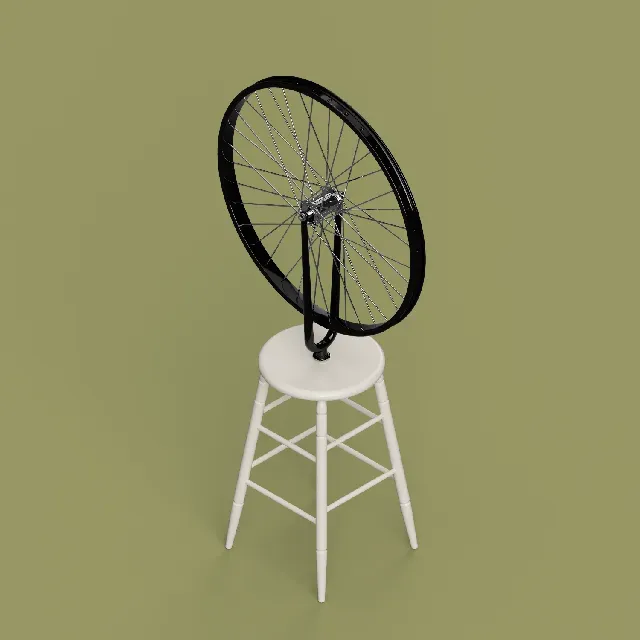


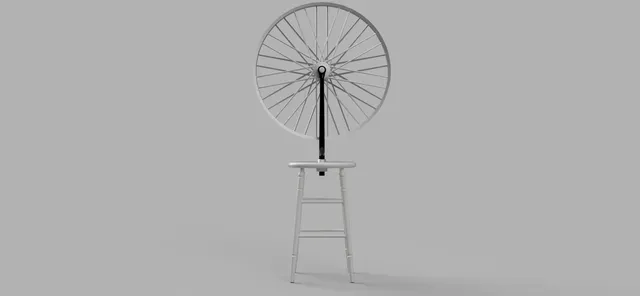
This open-access, reference-scale model is part of the broader project framework of Prêt à Faire: Printable Readymade Models . To explore the premium, full-scale editions operating under a distinct commercial framework as part of this marketplace critique, visit:
While full-scale exhibition prints operate under a distinct commercial framework, this reference iteration remains open-access.
🚲🚲🚲🚲🚲🚲🚲🚲🚲🚲🚲🚲🚲🚲
Interviewer, George Hamilton: Do you think anybody else could make one?
Marcel Duchamp: Yes, everybody can! Every century there is a new definition of art. So if we accept trying not to define art then the readymade comes in as a sort of irony, because here it is, a thing that I call art.
🚲🚲🚲🚲🚲🚲🚲🚲🚲🚲🚲🚲🚲🚲
1 | Concept & Provenance
This is a model based on Bicycle Wheel by Marcel Duchamp. The original from 1913 is lost; although my earlier versions of this model synthesized traits found in various replicas from 1916, 1951, 1960, and 1964, my most recent published iteration is a transformative interpretation that cross-references the public dimensional layout documented by the historical 1964 Galerie Schwarz variant.”
Why a printable version? In making this model, I'm fulfilling Duchamp's assertion that “Yes, everybody can” make one. 3D printing creates a conceptual condition in which the art object becomes even more accessible. We can even say it fulfills the idea of the original object when we are able to spin this working wheel — just try to get away with THAT in a museum!
A description of the work from the MoMA website :
“In 1913,” recalled Marcel Duchamp, “I had the happy idea to fasten a bicycle wheel to a kitchen stool and watch it turn.”1 The result, Bicycle Wheel , is the first of Duchamp’s Readymades —objects (sometimes manufactured or mass-produced) selected by the artist and designated as art. Most of Duchamp’s Readymades were individual objects that he repositioned or signed and called art, but Bicycle Wheel is what he called an “assisted Readymade,” made by combining more than one utilitarian item to form a work of art.
The work in MoMA’s collection is the third version of Bicycle Wheel . The first, now lost, was made nearly 40 years earlier, in 1913. Because the materials Duchamp selected to be Readymades were mass-produced, he did not consider any Readymade to be an original.
Find out more about this work at:
- Bicycle Wheel Wikipedia article
- Philadelphia Art Museum
- MoMA
- Kristina Seekamp at Tout Fait
Sample images of replicas:
Philadelphia 1964 replica
MoMA 1951 replica
Duchamp's NYC studio 1916 replica
I'm not the only artist who has toyed with this iconic work. Artist Elaine Sturtevant created a replica identical in size, material, and technique to the wheel, while Richard Pettibone created multiples , and Ji Lee reverts it to its original context.
Elaine Sturtevant, Duchamp Bicycle Wheel, 1969-73
Richard Pettibone's studio, 1965
Ji Lee, Duchamp Reloaded, 2009
2 | Scope & Scale
There have been several versions of this model published since the original version in May of 2025. The first model approached the idea of printing spokes with extreme caution, while later iterations took more risks. After completing the complex full-scale version for sale at my store , I found I could scale and simplify the details found there into a model that could print at about 50% scale. While the full-scale version is offered for sale, this one is (and will remain) free. I decided to keep three versions here for history and support, and you'll find things broken down as follows:
- V3: Most current iteration, based on the full-scale version, in 4 folders: the stool, the fork, the spoke/axles, and the rim. This is printable at 50% scale and comes pre-formatted as a 3MF plating file, though the original STEP and STL files are available at full size.
- V2: A much simpler version, printable at 25% on a Prusa MK4 and up to 50% on a Prusa XL. If you are doing a multi-material print, be aware that the model contains a weakness at the fork/stool connection—increase perimeters to compensate. All pieces are found in one folder.
- V1: For smaller scales and simpler assembly, this version features a permanent support fin, thinner than the spoke but still thick enough to create 2 perimeters at 25% scale. If using a multi-material setup, one can print the supports using a clear filament, while printing everything else in an opaque material. All pieces are found in one folder.
As a work of Post-Appropriation, V3 is an independent digital manifestation optimized specifically for FDM fabrication, structural durability, and scale variance. The geometry deliberately adapts historical visual motifs into a printable medium, celebrating the physical deviations required by the additive manufacturing process as part of the artwork's transformative expression.
- Printing at a scale smaller than 50% is not recommended , as it will compromise tolerances, bearing fits, and structural behavior.
- Many parts require a large-format printer such as a Prusa XL .
- An incredible full-scale version is available at this link .
3 | Printing Notes
3.1 | General Recommendations
- Use the supplied 3MF files with preconfigured orientations and settings.
- These settings were validated on a well-tuned Prusa XL using dehydrated filament.
- STL and STEP files are provided for users who wish to experiment.
- If creating your own build plates, print extras for the smaller pieces.




Названия используются только для указания источника результата. Polyzon не аффилирован с перечисленными площадками.