
Бесплатно 
Magnetic Separation Tube Rack 2 mL
Printables
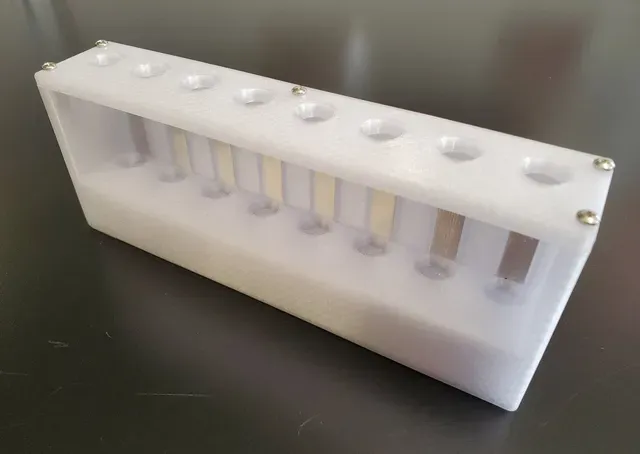
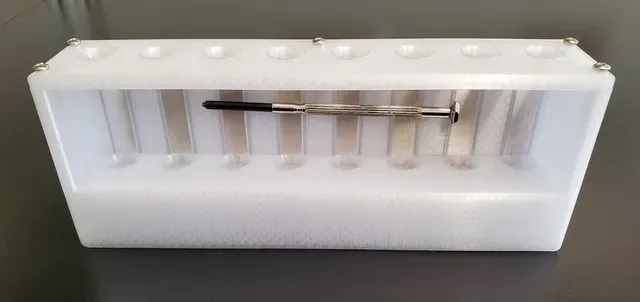
This is a tube rack for magnetic bead separation experiments. It was requested by a colleague due to the outrageous cost of commercial products (1), and the design was based on some 60×10×3 mm magnets they already had on hand (2), for common polystyrene test tubes (3).
I took a different approach with this versus other designs I have seen. Instead of having voids where you epoxy the magnets in place, I created channels you can slide the magnets into. I also made it in two-parts with a screw down lid. This means you can easily reclaim the magnets, you don't have to worry about anything smashing into and chipping the magnets, you can use any length (or even round disk) 10×3 mm magnets, you are less likely to have rusting from water exposure, you can customise the lid to fit different size tubes, and it requires no supports to print. To attach the lid, just slowly tap the holes for 4-40 and use a non-magnetic 4-40×3/4" screw (4). M3 would probably also work.
The base is very hefty for stability, but the length of the magnets also slides down into the based below the bottom of the tubes. A small 'spacer' is included; in the default configuration this sits above the magnets to hold them firmly in place but could also sit below the magnets to raise them higher.
- Outrageous! - Magnets! - Tubes! - Screws! Please note that this has not yet been extensively tested in a wide range of separation experiments! It is up to individuals to confirm it works for their application. If you use this design in a scientific manuscript, I only ask that you please state the design was received from Dr. Adrian West, cite this webpage, and send me a link to your published paper!
Print Settings
Printer: Ultimaker S3
Rafts: No
Supports: No
Resolution: 0.1 mm
Infill: 40% cubic
Filament: BASF Ultrafuse PET Clear
This is a very easy print. The only consideration is that you will get the best results with a 0.4 mm nozzle and exactly 0.4 mm line width in your slicer, because the channel walls that hold the magnet are exactly 0.8 mm thick. Material is not important, but I like PET(x) for labware because of the superior chemical resistance. I went a bit nuts with high infill to make it nice and heavy, but you could probably go as low as 20%. Use a good adhesion aid and a brim because the geometry has a tendency to warp.








Названия используются только для указания источника результата. Polyzon не аффилирован с перечисленными площадками.
Комментарии