
Бесплатно 
Linear-Motion Compliant Mechanism
Printables






Summary
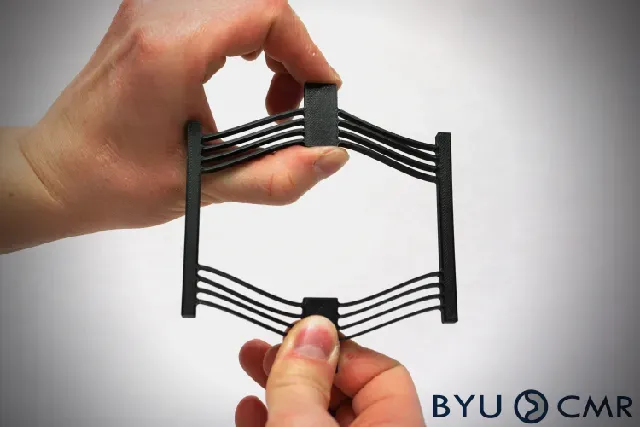
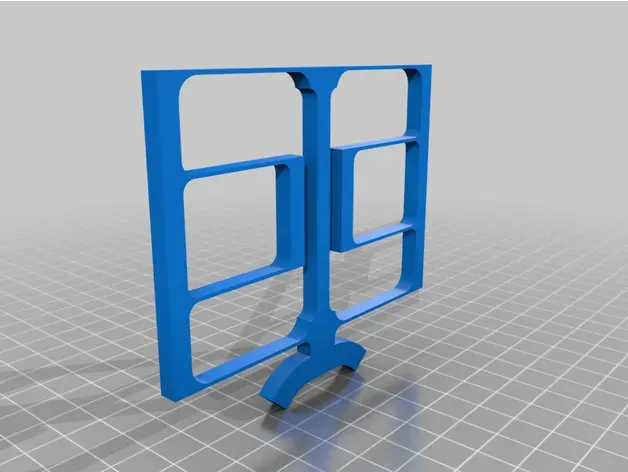
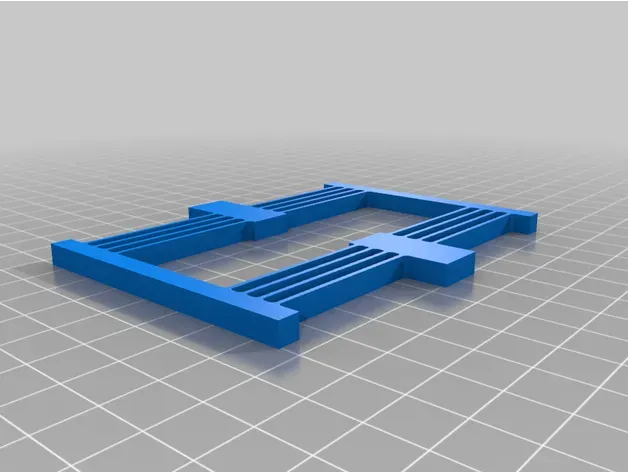
The following three designs are compliant linear-motion large-displacement mechanisms.
In traditional mechanism design, linear motion is highly desirable for position control, assembly of large systems, and more. Linear-motion mechanisms are usually constructed using a support structure that guides a shuttle in linear movement. This movement is generally achieved using prismatic joints. Prismatic joints are sliding joints that can restrict linear-motion devices to one degree of freedom; but these joints also present challenges including friction, wear, and difficult lubrication.
Because of these inherent issues, these linear-motion large-displacement mechanisms have been developed alternatives to prismatic joints that retain the desired linear motion. These compliant mechanisms have the benefit of decreased wear and no lubrication
Explanation
The three devices published here have been developed to create linear-motion in a generally large-displacement comparative to their footprint. Compliant mechanisms improve traditional linear-motion mechanisms by offering improved functionality, and decreased wear, friction, and cost of production.
Mechanisms
Folded Beam Suspension
The folded beam suspension is a popular design because of its simplicity and predictability. The basis of the device is a parallel-guiding mechanism, a linkage where the legs opposite each other are the same length. To form a folded-beam suspension, a number of parallel-guiding mechanisms are combined in series and parallels as shown in the image below. The Folded beam suspension shows high torsional off-axis stiffness but low transverse stiffness.
This combination of parallel-guiding devices constrains the shuttle to approximate straight-line motion.
X-Bob
The X-Bob, as illustrated below, is another example of a planar, large-displacement device consisting of a center shuttle on a compliant suspension. An X-Bob is created by combining four Robert’s mechanisms in a reflective way so as to restrain the shuttle’s movement to one-degree-of-freedom. The X-Bob configuration has proven to be effective for micro-systems; a micro machined version is also shown below. The X-Bob shows low torsional off-axis stiffness but high transverse stiffness.
Compliant Translational (CT) Joint
The CT joint was proposed colleagues at the University of Michigan as an improvement of a leaf spring joint, increasing the range of motion and improving the transverse stiffness. The mechanism is composed of compliant members constrained by the parallel arrangement of two identical plates. The joint can be modeled as a parallel four-bar mechanism and allows only pure translational motion. The CT joint is illustrated in the figure below; the dashed lines show the deflected state of the mechanism with the left plate being considered ground. Of these designs, the CT joint with thin flexures is the one with the longest travel but also has low off-axis stiffness in both transitional and torsional cases.
Application
Studies done in 2014 used large-displacement linear-motion mechanisms to create microelectromechanical grasping mechanisms that assisted in cell restraint.
In these studies, scientists/students used a pipette to drop a mouse embryo near the arms of the device and push it into place. Then, using the same pipette, they could push the mechanism, restraining the cell within its grasping arms and enabling the scientists to inject the secured embryo with ease.
Large-displacement linear-motion mechanisms can be applied in any products that use translating mechanisms such as: -Retractable devices/trays -Media ejectors -Linear positioning devices -Hand held electronics with sliding mechanics -Translational devices in harsh environments where lubrication is not an option
Compliant large-displacement linear-motion mechanisms have been used in a wide variety of products from micro to macro scale applications including microelectromechanical systems, switches, guides, and clutches. These devices' compliance give them many advantages over traditional linear-displacement mechanisms.
Learn More
This design was developed by the Compliant Mechanisms Research Group (CMR) from Brigham Young University (BYU). Follow us at @byucmr on Instagram or visit the BYU Compliant Mechanisms Research (CMR) website to learn more about compliant mechanisms.
See https://rdcu.be/dnHx0 for an article in Nature Communications about how and why we share these maker resources.
Technical Information
For in-depth technical information, see the following publications:
Fowler, Robert M., et al. " Flex-16: A large-displacement monolithic compliant rotational hinge ." Mechanism and Machine Theory 82 (2014): 203-217.
Hubbard, N. B., Wittwer, J. W., Kennedy, J. A., Wilcox, D. L., & Howell, L. L. (2004). A novel fully compliant planar linear-motion mechanism 57008. Paper presented at the Proceedings of the ASME Design Engineering Technical Conference, , 2 A 1-5,
MacKay, A. B., Smith, D. G., Magleby, S. P., Jensen, B. D., & Howell, L. L. (2012). “ Metrics for evaluation and design of large-displacement linear-motion compliant mechanisms .” Journal of Mechanical Design, Transactions of the ASME, 134(1) doi:10.1115/1.4004191,
Mackay, A.B., Smith, D.G., Magleby, S.P., Jensen, B.D., Howell, L.L., “ Metrics for Evaluation and Design of Large-displacement Linear-motion Compliant Mechanisms ,” Journal of Mechanical Design, DOI: 10.1115/1.4004191, Vol. 134, pp. 0011008-1 to 0011008-9, 2012.
Smith, D. G., Larsen, G. T., & Howell, L. L. (2010). Design optimization of a linear-motion large-displacement micro mechanism for high off-axis stiffness . Paper presented at the Proceedings of the ASME International Design Engineering Technical Conferences and Computers and Information in Engineering Conference 2009, DETC2009, , 6 459-464. doi:10.1115/DETC2009-87301.
Toone, N. C., Fazio, W. C., Lund, J. M., Teichert, G. H., Jensen, B. D., Burnett, S. H., & Howell, L. L. (2014). Investigation of unique carbon nanotube cell restraint compliant mechanisms. Mechanics Based Design of Structures and Machines, 42(3), 343-354. doi:10.1080/15397734.2014.908298.
Trease, B. P., Moon, Y.-M., and Kota, S., 2005, “ Design of Large-Displacement Compliant Joints ”. ASME J. Mechan. Des., 127(4), pp. 788–798.
To learn more about compliant mechanisms in general, see the BYU Compliant Mechanisms Research (CMR) website or these books: Compliant Mechanisms , Handbook of Compliant Mechanisms
Intellectual Property
The downloadable 3D print files provided here may be used, modified, and enjoyed for noncommercial use. To license this technology for commercial applications, contact:
BYU Technology Transfer Office
3760 Harold B. Lee Library
Brigham Young University
Provo, UT 84602
Phone: (801) 422-6266
https://techtransfer.byu.edu/contact


Названия используются только для указания источника результата. Polyzon не аффилирован с перечисленными площадками.
Комментарии